Platypus Facts
The platypus is an Australian freshwater mammal with webbed feet, dense fur, and a wide bill that senses prey underwater. A female lays eggs in a bank-side burrow and feeds her young milk after they hatch. Together, those traits make it one of the best examples of how varied mammals can be.
| Scientific name | Ornithorhynchus anatinus |
|---|---|
| Animal group | Mammals |
| Order | Monotremata (egg-laying mammals) |
| Length | Average about 43 cm (17 in) in females and 50 cm (20 in) in males, including tail |
| Weight | Average about 0.9 kg (2 lb) in females and 1.7 kg (3.7 lb) in males |
| Lifespan | Up to 24 years recorded in the wild |
| Diet | Freshwater insect larvae and other small aquatic animals |
| Habitat | Creeks, rivers, and connected freshwater bodies in eastern Australia and Tasmania |
| Conservation | Near Threatened on the IUCN Red List |
What does a platypus look like?
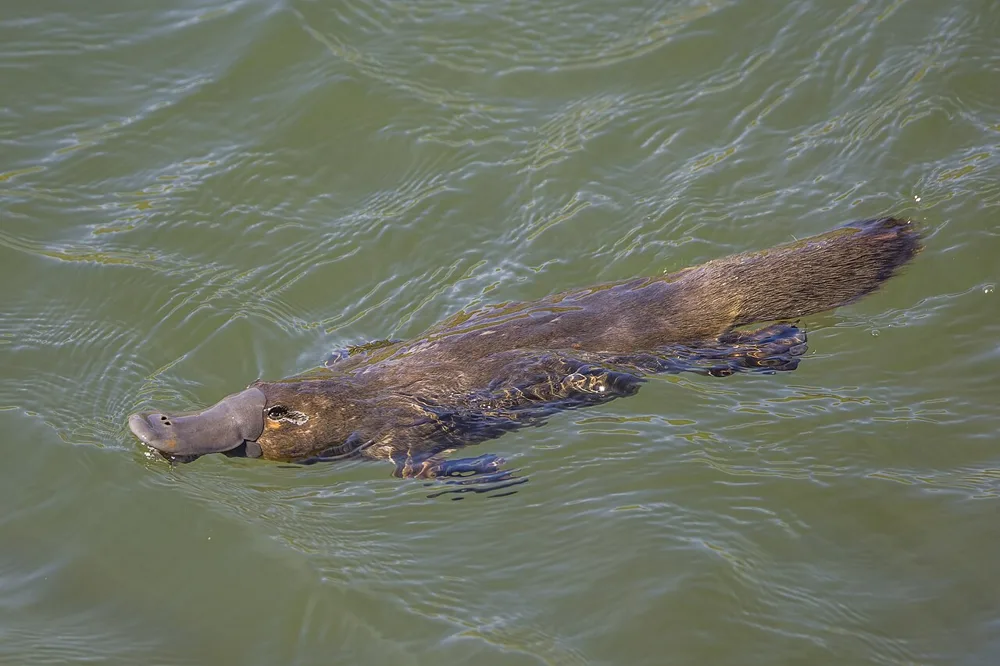
The platypus has a low, rounded body with brown fur, a broad tail, and short legs. From the side, the flattened bill projects well beyond the head. Its forefeet have webbing that helps push it through water. While walking, it can fold the webbing back so the claws work on land or against the soil of a bank.
Adult males are usually larger than females, and body size varies across the animal’s range. Males also have a spur on each hind ankle connected to a venom gland. You may see only a head, back, and tail above the surface when an animal is swimming. A full view of the feet often comes from a photo taken on land.
Where do platypuses live?
Wild platypuses live in eastern Australia, including Tasmania. They use creeks, rivers, and other freshwater bodies where they can find food along the bottom. A usable stretch of water also needs banks or nearby ground suitable for burrows. Aquatic food and dry shelter can therefore be close together in the same small area.
A platypus may travel along a waterway and dive repeatedly as it searches. Watch the surface in a quiet place and you may notice a low shape moving through the water before it disappears. The burrow is where the animal can rest out of sight, and a female prepares a separate nesting burrow when raising young.
What do platypuses eat?
Much of the platypus diet comes from the streambed. It eats insect larvae as well as prey such as worms and small crustaceans. Underwater it shuts its eyes and ears. Receptors in the bill pick up touch and weak electric signals produced by moving prey, which helps the animal search through water and sediment.
Small prey can be held in cheek pouches while the platypus is submerged. At the surface it processes the food with hard grinding pads. Notice the difference between finding food and eating it. A dive is the search, while a quiet pause at the surface can be the time spent chewing.
Platypus eggs and young
A female makes a nest in a burrow and lays a small clutch, often two eggs. The eggs are leathery and hatch after an incubation period estimated at around ten days. The young are very small and depend on the shelter of the burrow while they grow.
Female platypuses produce milk, but they have no nipples. The young obtain milk from areas of skin on the mother’s underside and stay in the burrow for the first months of life. A record of a long-lived adult is an upper observation. It does not tell you that most animals in a river reach the same age.
Are platypuses endangered?
The Australian Museum reports a global Near Threatened assessment. Conservation status can differ under state or national systems. Checking which system a label refers to is especially useful for a species that lives across several Australian jurisdictions.
Platypuses depend on healthy freshwater systems. Drought, altered water flows, degradation of banks, and other changes can make a stretch of river less useful for feeding or shelter. Conservation work includes protecting habitat and studying where populations persist. Long-term records help researchers tell whether a change in sightings reflects a local shift or a broader decline.
Platypus fun facts
- The platypus and echidnas belong to the living egg-laying mammals.
- The front feet provide most of the power when it swims.
- A sensory bill helps it find prey with its eyes closed.
- Cheek pouches carry food to the surface.
- Adult males have a venom-delivering spur on each hind ankle.
- Females feed hatchlings milk inside a nesting burrow.
How to draw a platypus
- Sketch a long, low oval for the body. Put a smaller head close to the front, with very little neck showing.
- Add a wide bill with a blunt rounded tip. Use the photograph to judge how much it projects past the head.
- Taper the back into a broad flat tail. Place the short forelegs where the body begins to widen.
- Draw the webbing as thin curves between toes. Shade the body with short marks and leave the bill relatively smooth.
Platypus quiz for kids
Where does a female platypus raise her young?
In a nesting burrow, usually dug into the bank.
Which body part helps a platypus detect prey underwater?
Its bill, which can detect touch and weak electric signals.
Does a platypus lay eggs or give birth to live young?
It lays eggs, then feeds the hatchlings milk.
Frequently asked questions
Is a platypus a mammal?
Yes. It has fur and feeds its young milk. It is a monotreme, a member of the group of mammals that lay eggs.
Where can you find platypuses in the wild?
They occur in eastern mainland Australia and Tasmania, where suitable freshwater habitats provide prey and places for burrows.
How big is a platypus?
Females average about 43 centimeters and males about 50 centimeters, including the tail. Sizes vary with sex and across the range.
Do both sexes have venomous spurs?
The functional venom-delivering spurs are on the hind ankles of adult males.
How long can a platypus live?
The Australian Platypus Conservancy cites a recorded wild lifespan of up to 24 years. Many animals in field studies are last recorded much earlier.
Sources
- Australian Museum — Platypus
- Australian Platypus Conservancy — Platypus vital statistics
- Queensland Government — Platypus habitat and conservation
View catalog data and filter classifications · View photo attribution
Related animals
- Eurasian beaver Castor fiber
- American mink Neogale vison
- Sea Otter Enhydra lutris
- Capybara Hydrochoerus hydrochaeris