Capybara Facts
A capybara is the largest living rodent. It grazes on land and slips into freshwater to cool off or hide. Its eyes, ears, and nostrils sit high on the head, so much of the body can stay under the surface while the animal watches, listens, and breathes.
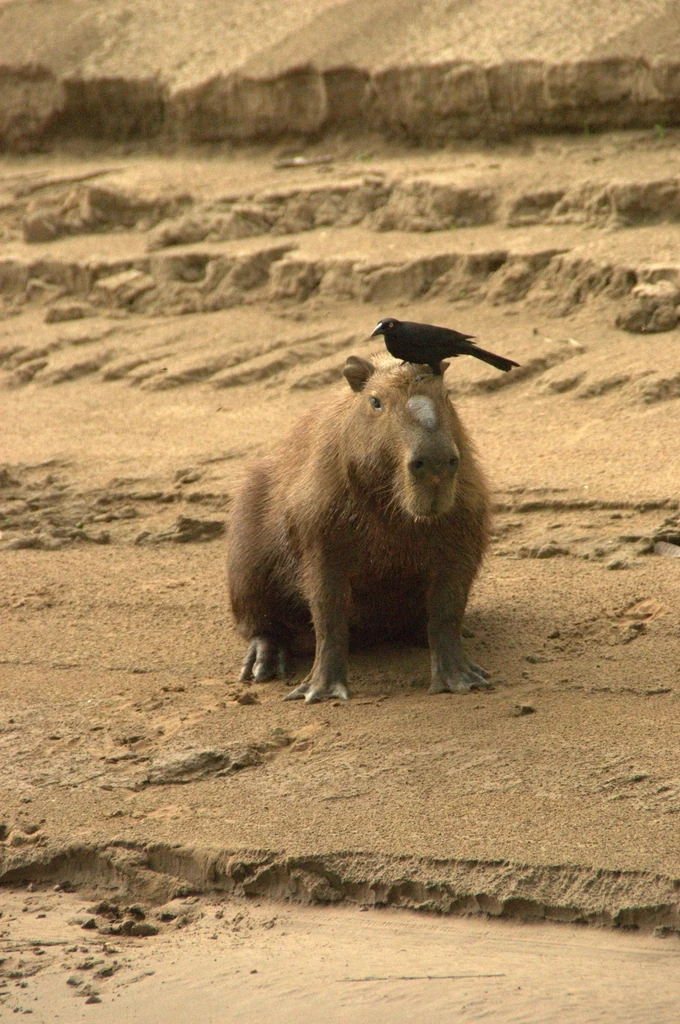
| Scientific name | Hydrochoerus hydrochaeris |
|---|---|
| Animal group | Mammals |
| Family | Caviidae (cavies and relatives) |
| Length | About 1.2 m (4 ft) in large adults |
| Weight | About 35–66 kg (77–146 lb) |
| Lifespan | About 6 years on average in the wild in the cited account |
| Diet | Grasses, aquatic plants, and other plant material |
| Habitat | Rivers, marshes, flooded grasslands, and other freshwater edges in South America |
| Conservation | Least Concern on the IUCN Red List (2016 assessment) |
What does a capybara look like?
A capybara has a bulky body, coarse brown hair, short legs, and a squared muzzle. In profile, the head meets the back with only a modest change in height. Its small ears and high-set eyes give the head a distinctive outline. A tail is barely visible, so a long tail in a sketch can make an otherwise accurate animal look like a different rodent.
The feet are partly webbed. There are four toes on each front foot and three on each hind foot. Look for the feet in a whole-body reference. A photo of an animal floating may show only the top of the head, yet that view is a good way to see how the position of its eyes and nose suits life in the water.
Where do capybaras live?
Capybaras are native to South America, where they live near permanent or seasonal freshwater. Marshes, lakes, riverbanks, and flooded grasslands offer combinations of water, cover, and grazing space. They need places to feed on land as well as water they can enter readily. On hot days a group may rest partly submerged.
The same wetland can look quite different across the seasons. As water becomes scarce, animals can gather around the remaining water. The number you see at one watering place may therefore reflect the season as much as the size of the wider population. Look for nearby vegetation and open patches if you are comparing habitat photographs.
What do capybaras eat?
Capybaras mostly graze on grasses and also eat aquatic vegetation. Which plants they take varies with what is growing in the area. For a classroom comparison, put a shoreline photo beside a feeding photo and identify the two places the animal can reach plants. A riverbank provides both a route into the water and access to plant food on land.
Capybaras have the continuously growing incisors typical of rodents. Repeated biting and chewing wears the teeth as they grow. That combination makes sense for a grazer eating tough vegetation day after day.
Capybara babies and group life
Capybaras often live in social groups with multiple adults and their young. A mother gives birth to live young, which have fur and are mobile soon after birth. They start to explore and eat plants while continuing to nurse. Staying near the group gives the young a chance to follow adults between grazing patches and water.
Group size varies. A small family on a bank may be easier to observe than a larger gathering during the dry season, when access to water is limited. Animal Diversity Web reports an average wild lifespan of about six years in its account. Some wild capybaras live longer, and lifespans under human care are reported separately.
Are capybaras endangered?
The IUCN lists the greater capybara as Least Concern. That category describes the species at a global scale. Local numbers can still change where wetlands are drained, animals are hunted, or people and wildlife compete for the same space.
This guide describes the greater capybara, Hydrochoerus hydrochaeris. The lesser capybara is a separate species with a more restricted range. When comparing size, range, or conservation status across sources, use the scientific name to make sure both sources describe the same animal.
Capybara fun facts
- The greater capybara is the largest living rodent.
- Its closest living family includes guinea pigs and other cavies.
- High-set eyes and nostrils are useful when the body is submerged.
- The front and back feet have different numbers of toes.
- A calf can move with the group soon after it is born.
- Grazing areas and a route to freshwater are both important parts of its habitat.
How to draw a capybara
- Block in a wide oval for the body and a smaller, boxier shape for the head. Keep the neck short.
- Place the rounded ears high and toward the back of the head. Set the eyes and nose close to the top of the face.
- Add short legs and draw the weight of the body above them. Use only a few marks to show the toes.
- Build the coarse coat with clusters of short strokes. Keep the muzzle smoother and leave the outline readable at a glance.
Capybara quiz for kids
Is a capybara a rodent or a small hippopotamus?
It is a rodent, related to guinea pigs.
Why are its eyes and nose high on its head?
They can stay above the surface while much of the body is under water.
What kind of food does a capybara mainly eat?
Plants, especially grasses and aquatic vegetation.
Frequently asked questions
Are capybaras good swimmers?
Yes. They have partly webbed feet and regularly enter freshwater to cool off, move through their habitat, or seek shelter.
How much does a capybara weigh?
Animal Diversity Web reports a range of about 35 to 66 kilograms for the greater capybara.
Are capybaras related to guinea pigs?
Yes. Both belong to the cavy family Caviidae.
Where are capybaras from?
Greater capybaras are native to South America, where they inhabit freshwater edges including rivers, marshes, and seasonally flooded grasslands.
Do capybaras live in groups?
They usually live socially. The number in a group varies and larger gatherings may form around the remaining water during dry conditions.
Sources
- University of Michigan Animal Diversity Web — Hydrochoerus hydrochaeris
- IUCN Red List — Greater capybara assessment
- American Society of Mammalogists — Greater capybara taxonomy
View catalog data and filter classifications · View photo attribution
Related animals
- Eurasian beaver Castor fiber
- Platypus Ornithorhynchus anatinus
- Hippopotamus Hippopotamus amphibius
- Sea Otter Enhydra lutris