Red Panda Facts
A red panda has rust-colored fur, dark legs, and a long ringed tail. It spends much of its time in trees in cool mountain forests, where bamboo makes up most of its diet. Although it shares a name and a favorite food with the giant panda, it belongs to a different family.
| Scientific name | Ailurus fulgens |
|---|---|
| Animal group | Mammals |
| Family | Ailuridae |
| Head and body length | About 56–63 cm (22–25 in); the tail adds roughly 37–47 cm (15–19 in) |
| Weight | About 3.6–7.7 kg (8–17 lb) |
| Lifespan | About 8 years in the wild in the San Francisco Zoo profile; longer lives are possible under human care |
| Diet | Mostly bamboo leaves and tender shoots |
| Habitat | Cool mountain forests with bamboo in the Himalayas and neighboring ranges |
| Conservation | Endangered |
What does a red panda look like?
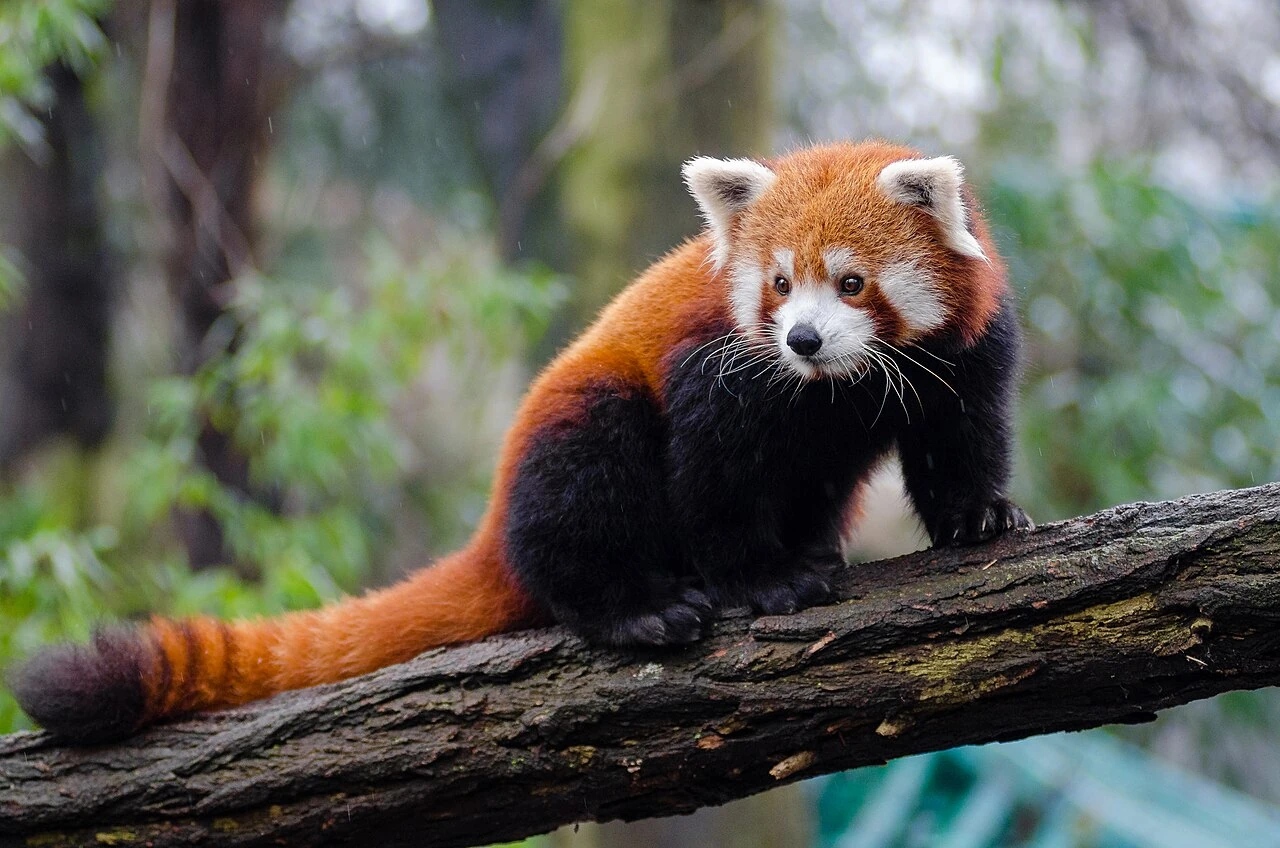
A red panda has pale cheeks, pale ear edges, a dark underside, and a reddish back. Bands of color run along its bushy tail. That combination is easy to spot in a full-body photo even when the animal is standing in shade. Look at the white face patches separately from the shadow under the chin, since those shapes help distinguish the head from the front legs.
The tail helps the animal balance on branches. It can also curl around the body while the panda rests in cool conditions. Strong claws help it grip bark. From a distance, the animal may look larger than it really is because the thick fur and long tail add volume to the outline.
Where do red pandas live?
Red pandas live in cool, high-elevation forests in the Himalayas and neighboring mountains. Bamboo in the understory gives them access to food, while trees provide places to climb, rest, and raise young. A forest patch needs both the food layer below and enough suitable tree cover to be useful.
The name red panda is used for populations across a range that extends from Nepal and nearby Himalayan countries into parts of Myanmar and China. Some genetic research separates the Himalayan and Chinese red pandas as distinct species. This guide uses the name Ailurus fulgens from the catalog. When comparing range maps, check whether they show Himalayan animals alone or red pandas broadly.
What do red pandas eat?
Bamboo leaves and tender shoots make up most of a red panda’s diet. It selects parts it can eat readily and holds stems with its forepaws. A wrist bone forms a projection that helps with that grip. It can look like an extra finger in an illustration, although it is an extension of the wrist.
A red panda can also eat other foods, such as fruit and occasional animal matter. Its bamboo-heavy diet is distinct from its classification in the mammal order Carnivora. The name of an evolutionary group does not tell you what every member eats today.
Red panda cubs and life cycle
Adult red pandas usually spend much of their time alone. A mother prepares a protected spot such as a hollow tree or den before giving birth. Litters often have two cubs. The young are born small and depend on their mother for warmth and milk while they grow.
Cubs stay with their mother for months before becoming independent. As they grow, they begin to explore and learn to climb. Lifespan figures are best read with their setting in mind. A reported age for a long-lived zoo animal describes what was possible under those conditions, while a wild estimate includes different risks and pressures.
Are red pandas endangered?
Red pandas are endangered. Clearing and degradation can remove bamboo and nesting trees, and fragmentation leaves suitable patches separated from one another. A forest can appear green from above while still being difficult for an animal to move through if the useful patches are cut apart.
Poaching and other human pressures also affect wild populations. Protecting forest habitat and connections between patches can help animals reach food, shelter, and mates. To understand a conservation claim, look for both its geographic area and its definition of the species, since range and status summaries may use different taxonomies.
Red Panda fun facts
- Red pandas use a wrist-bone projection to help hold bamboo.
- Their ringed tail works as a counterbalance on branches.
- The feet and underside are darker than the reddish back.
- Red pandas and giant pandas belong to different mammal families.
- A hollow tree can provide a protected place for a mother and cubs.
- Although bamboo dominates the diet, red pandas belong to the order Carnivora.
How to draw a red panda
- Start with a round head, a compact body, and a branch at the angle shown in the photo.
- Place the two ears near the top of the head. Mark the cheek patches and short muzzle before drawing fur.
- Give the tail a clear curve. Wrap the bands around its form so they follow the change in angle.
- Separate the reddish back from the dark legs with broad areas of tone. Add only a few fur strokes along the edges you want to emphasize.
Red Panda quiz for kids
What makes up most of a red panda’s diet?
Bamboo leaves and tender shoots.
What helps the panda keep its balance on a branch?
Its long, bushy tail.
Is the red panda in the same family as the giant panda?
No. The red panda belongs to Ailuridae and the giant panda is in the bear family.
Frequently asked questions
How big is a red panda?
The Smithsonian profile gives a head and body length of about 56 to 63 centimeters, with a long tail that adds another 37 to 47 centimeters.
Where do red pandas sleep?
They often rest on branches. In cool conditions they can curl up and bring the tail close to the body.
Do red pandas eat anything besides bamboo?
Yes. Bamboo is the main food, but they also eat other foods such as fruit and occasional small animal prey.
Why are red pandas endangered?
Loss and fragmentation of mountain forests are major threats. Poaching and other human pressures can also harm local populations.
Can red pandas climb?
Yes. Their claws grip bark, and their long tail helps them balance when they move on branches.
Sources
- Smithsonian’s National Zoo — Red panda habitat, size, and life history
- Muséum national d’Histoire naturelle — Red panda anatomy and conservation
- San Francisco Zoo — Red panda lifespan and habitat
View catalog data and filter classifications · View photo attribution
Related animals
- Giant panda Ailuropoda melanoleuca
- Raccoon Procyon lotor
- Least weasel Mustela nivalis
- Sea Otter Enhydra lutris