Moon Jellyfish Facts
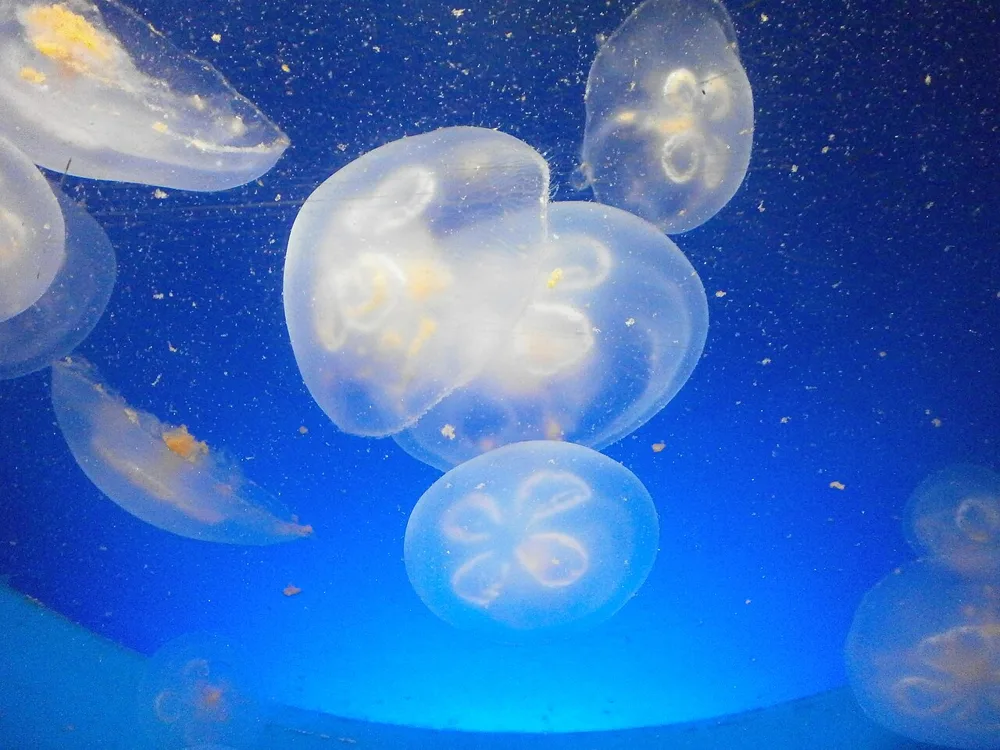
A moon jellyfish looks like a translucent disk with four little horseshoes inside. Those marks help you recognize it, but most of its life story is hidden from view. The swimming jelly begins as a larva that settles on a surface and grows into a tiny attached animal.
| Scientific name | Aurelia aurita |
|---|---|
| Animal group | Invertebrates |
| Class | Scyphozoa (true jellyfish) |
| Bell diameter | Up to about 30 cm (12 in) in the National Aquarium’s species profile |
| Weight | Highly variable with bell size and water content |
| Lifespan | The free-swimming stage often lasts months, varying with conditions |
| Diet | Zooplankton and other tiny drifting animals |
| Habitat | Coastal seawater, including sheltered bays and harbors |
| Conservation | No global threat category cited in the references below |
What does a moon jellyfish look like?
Look down through the bell and you may see four horseshoe-shaped reproductive organs arranged around its center. The bell is shallow and nearly round when viewed from above. Along its edge is a fine fringe of short tentacles. The broader, folded structures nearer the mouth are oral arms. If you are looking at a photograph, follow the rim before deciding which structures belong to the edge and which are inside.
The round form changes with the animal’s movements. As the bell contracts and relaxes, it pushes water and moves. From the side, the same jelly that looked circular a moment ago can look like a flattened bowl. That is a change of angle or posture rather than a different body plan.
Where do moon jellyfish live?
Moon jellies are familiar in sheltered coastal waters, including bays and harbors. The swimming stage can appear near the surface. The attached stage uses a very different part of the habitat, settling on submerged surfaces instead of drifting through the water. Seeing adults in one spot therefore tells you little about where the earlier stages are hiding.
The name moon jelly also covers several similar species in the genus Aurelia. Aquarium displays and guides sometimes describe the genus as a whole. This profile follows the catalog’s identification of Aurelia aurita. A locality or a set of four rings alone may be insufficient to distinguish closely related moon jellies.
What do moon jellyfish eat?
The floating jelly feeds on zooplankton, which includes small crustaceans and other tiny animals carried through the water. Short tentacles and the mucus near the bell help collect food. The oral arms help move captured material toward the mouth. This system works at the scale of tiny prey, so the tentacles can be easy to overlook in a still photo.
An adult moon jelly may drift with a current while continuing to pulse and feed. In turn, jellies are food for other animals, including some sea turtles and fish. A drifting jelly is part of a food web even when the animals it catches are too small to see from shore.
How does a moon jellyfish grow?
After fertilization, the female broods small larvae on her oral arms. The larvae eventually leave, settle on a submerged surface, and grow into polyps. A polyp can produce several little swimming jellies called ephyrae. Each ephyra grows into the bell-shaped medusa that most people recognize.
The stages differ in shape, location, and how they move. A polyp stays attached, an ephyra swims with a lobed outline, and the adult has a broad bell. Temperature and food can affect growth and reproduction. Lifespan figures need to say which stage they refer to, since an attached polyp and a swimming adult can persist for different lengths of time.
What affects moon jellyfish populations?
A dense patch of jellies is often called a bloom. Seeing a bloom describes what is happening in that place at that time. Currents can concentrate animals, and local conditions and predator numbers can affect how many survive. A single observation is a poor basis for judging whether a jelly population is increasing everywhere.
The National Aquarium describes jellies as part of the coastal food web, where fish and turtles consume them. When comparing records, check the locality, season, and exact species name. Those details matter more than a worldwide claim built from one crowded bay or one aquarium display.
Moon Jellyfish fun facts
- The four horseshoes are reproductive organs.
- The fringe of tentacles is much shorter than the trailing tentacles of many sea nettles.
- A swimming adult and an attached polyp are stages of the same life cycle.
- A newly released ephyra has a lobed outline before it develops the familiar round bell.
- The bell can look round from above and saucer-shaped from the side.
- The moon jelly’s prey includes tiny crustaceans that drift in coastal water.
How to draw a moon jellyfish
- Start with a flattened oval for the bell. Tip its far edge upward if your reference shows the jelly from the side.
- Place four curved marks around the center. Leave a clear gap between each one so the pattern reads through the bell.
- Draw a fine, irregular fringe at the margin. Place the broader oral arms nearer the middle.
- Keep the center pale. Add a thin light edge and a darker background to suggest transparent tissue without outlining every fold.
Moon Jellyfish quiz for kids
Which part of the moon jelly looks like four little horseshoes?
Its reproductive organs, which are visible through the bell.
Which stage attaches to a submerged surface?
The polyp.
Does it mainly catch large fish or tiny drifting animals?
Tiny drifting animals, including zooplankton.
Frequently asked questions
Is a moon jellyfish a fish?
It is an invertebrate in the phylum Cnidaria. It has a soft bell and stinging cells, and belongs to a different animal group from fish.
How large is a moon jellyfish?
The National Aquarium’s Aurelia aurita profile gives a bell diameter up to about 30 centimeters. Measurements for other Aurelia species can differ.
Can a moon jellyfish sting?
It has stinging cells used to catch prey. The National Aquarium describes its sting as mild. Identification from a quick look can be unreliable, so observe jellies without handling them.
Why do moon jellies gather near the surface?
Swimming jellies can drift and accumulate with currents. Conditions in shallow bays and harbors can also make them especially visible at certain times of year.
What is a baby moon jelly called?
The larva is called a planula. After the attached polyp stage, a newly released swimming jelly is called an ephyra.
Sources
- National Aquarium — Moon jelly
- Monterey Bay Aquarium — Moon jellies and their life cycle
- University of Michigan Animal Diversity Web — Aurelia aurita
View catalog data and filter classifications · View photo attribution
Related animals
- Beadlet anemone Actinia equina
- Pacific Purple Sea Urchin Strongylocentrotus purpuratus
- Cuttlefish Sepia officinalis
- Common octopus Octopus vulgaris