Greater Flamingo Facts
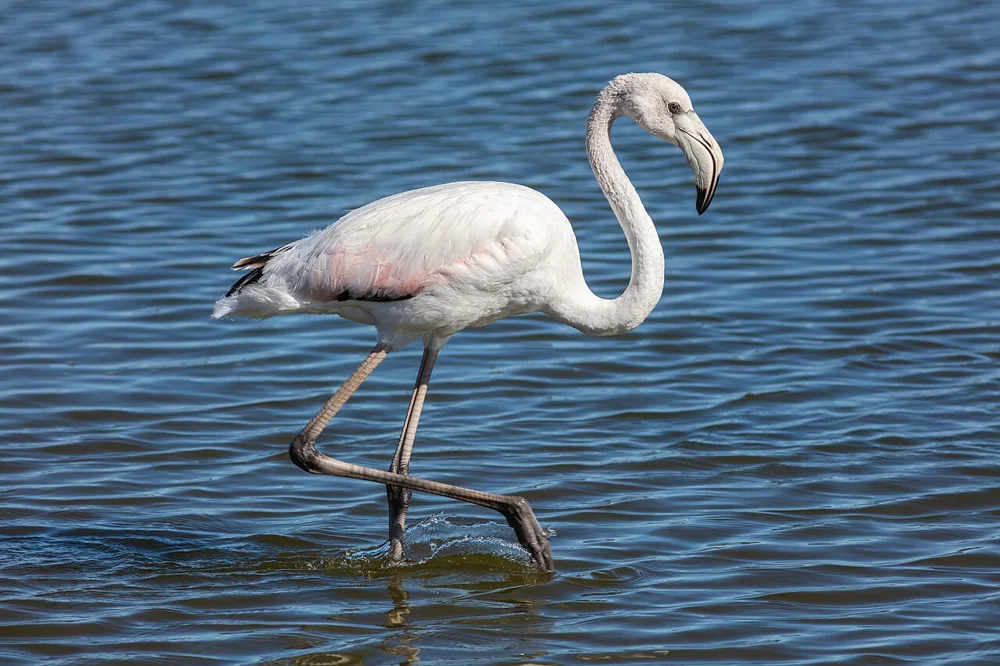
A greater flamingo walks on long legs through shallow water and can feed with its head tipped down and its bill upside down. A fine filter inside the bill lets it collect small food particles. Some of the pigments in that food help give adult birds their pink color.
| Scientific name | Phoenicopterus roseus |
|---|---|
| Animal group | Birds |
| Family | Phoenicopteridae (flamingos) |
| Height | About 120–145 cm (3.9–4.8 ft) in the San Diego Zoo profile |
| Weight | About 1.9–3 kg (4.2–6.6 lb) in the cited species account |
| Lifespan | Often 20–30 years in the cited account; some birds live longer |
| Diet | Small aquatic invertebrates, algae, and other filtered food particles |
| Habitat | Shallow lakes, lagoons, tidal flats, and other wetlands in Africa, southern Europe, and parts of Asia |
| Conservation | Least Concern globally |
What does a greater flamingo look like?
The greater flamingo is a tall wader with a long neck, long legs, and a downward bend in the bill. Its feathers can look nearly white or pale pink at rest. A flying bird can show stronger color on the wings and dark flight feathers. The legs and neck make a long straight line in flight, quite different from the curves of a bird feeding.
Look closely at the bend partway down the leg. That visible joint is the ankle. The knee is higher, near the body. In a drawing, keeping the high joint close to the body and the visible bend lower down helps the standing pose look like a bird rather than a person on stilts.
Where do greater flamingos live?
Greater flamingos use shallow wetlands across parts of Africa, southern Europe, and Asia. Feeding sites include salt lakes, coastal lagoons, and tidal flats. Shallow water gives the birds room to wade with their heads lowered. Different flocks may move when water levels rise or fall and feeding conditions change.
An area suitable for feeding is not always suitable for nesting. Breeding birds need a place to build nests that stays usable long enough for eggs to hatch and chicks to grow. This helps explain why a landscape with several connected wetlands can matter more than a single attractive pond.
What do greater flamingos eat?
Greater flamingos filter algae and small animals such as crustaceans from the water and soft sediment. When the bird dips its head, the bill turns upside down. The tongue helps move water through thin plates inside the bill. These plates trap small food particles while water leaves.
Carotenoid pigments from food contribute to the colors of the feathers. Chicks start out with pale or gray down and develop adult colors as they grow. The color of one bird can depend on age and diet, so the palest bird in a flock may still be a greater flamingo.
Greater flamingo chicks and nesting colonies
Flamingos often nest in colonies. The parents build a mound of mud with a shallow dip on top, usually for one egg. Both parents can incubate the egg and help feed the chick after it hatches. They produce a nutrient-rich food commonly called crop milk.
As chicks grow, they gather with other chicks in groups called crèches. Their bills change shape as they mature, eventually developing the pronounced bend useful for filtering. A chick in a colony can therefore look quite different from an adult in both color and bill shape. Long-lived adults may return to suitable breeding areas over many seasons.
Are greater flamingos endangered?
The greater flamingo is assessed as Least Concern globally. Regional trends can differ. Some important colonies are concentrated in a few suitable wetlands, so disruptions during nesting can affect many birds even when the species remains widespread.
BirdLife South Africa identifies changes in water levels, pollution, habitat loss, and disturbance as concerns for breeding and feeding sites. Conservation work includes protecting wetland systems and allowing enough space for birds to feed or nest without disturbance. A wetland can be important even if flamingos are present for only part of the year.
Greater Flamingo fun facts
- Greater flamingos are the tallest of the flamingo species.
- Their feeding bill works while it is held upside down.
- Thin plates inside the bill trap food particles.
- Pigments from food contribute to pink feathers.
- Parents usually lay one egg on a mound of mud.
- Both parents can feed the chick a secretion known as crop milk.
How to draw a greater flamingo
- Place a broad oval for the body. Leave more room above and below it than you would for a short-legged bird.
- Draw an S-shaped line from the body to the head. Add a second line to give the neck thickness.
- Mark the downward kink in the bill and darken the tip. Draw two slender legs and compare the angles at their visible joints.
- Use pale pink or gray for most of the body. Save stronger pink or black for the markings you can actually see in the reference.
Greater Flamingo quiz for kids
What helps make adult flamingo feathers pink?
Carotenoid pigments in the birds’ food.
What does the bent bill do when a flamingo feeds?
It filters small food particles from water and sediment.
What material is used to make the nest mound?
Mud.
Frequently asked questions
Are flamingos born pink?
Chicks have pale or gray down. The characteristic adult color develops later, with pigments from food contributing to the color.
How tall is a greater flamingo?
San Diego Zoo gives a height of about 120 to 145 centimeters for the greater flamingo. Other flamingo species may be shorter.
Is the greater flamingo the same as the American flamingo?
They are different species. The greater flamingo is Phoenicopterus roseus, while the American flamingo is Phoenicopterus ruber.
How many eggs do greater flamingos lay?
Usually one per nesting attempt. Both parents can take turns incubating it.
Can flamingos fly?
Yes. In flight they stretch the neck forward and the legs behind them. The spread wings can reveal dark flight feathers.
Sources
- UNEP African-Eurasian Waterbird Agreement — Greater flamingo range and status
- University of Michigan Animal Diversity Web — Phoenicopterus roseus
- San Diego Zoo Wildlife Alliance — Flamingo size and natural history
- BirdLife South Africa — Greater flamingo habitat and threats
View catalog data and filter classifications · View photo attribution
Related animals
- Scarlet ibis Eudocimus ruber
- Grey heron Ardea cinerea
- Snowy egret Egretta thula
- White stork Ciconia ciconia